
Monroe Hotel Miami Beach: A $75.1 Million Commercial Real Estate Financing Case Study
Published on September 6, 2026

Ethan Williams
Commercial Real Estate Finance Manager
Key Takeaways
- Different parts of a project may be better suited to different sources of capital — the Monroe Hotel used four distinct financing sources
- The capital stack included C-PACE financing ($44M), construction debt ($24.8M), bridge financing ($6.3M), and historic tax-credit equity
- The financing product should correspond to the underlying use of funds
- Timing can be just as important as the amount of financing
- These principles apply to businesses of all sizes, not just large commercial real estate projects
The Monroe Hotel Financing at a Glance
A major hotel redevelopment in Miami Beach offers an interesting real-world example of how commercial projects can use multiple forms of financing rather than relying on a single loan.
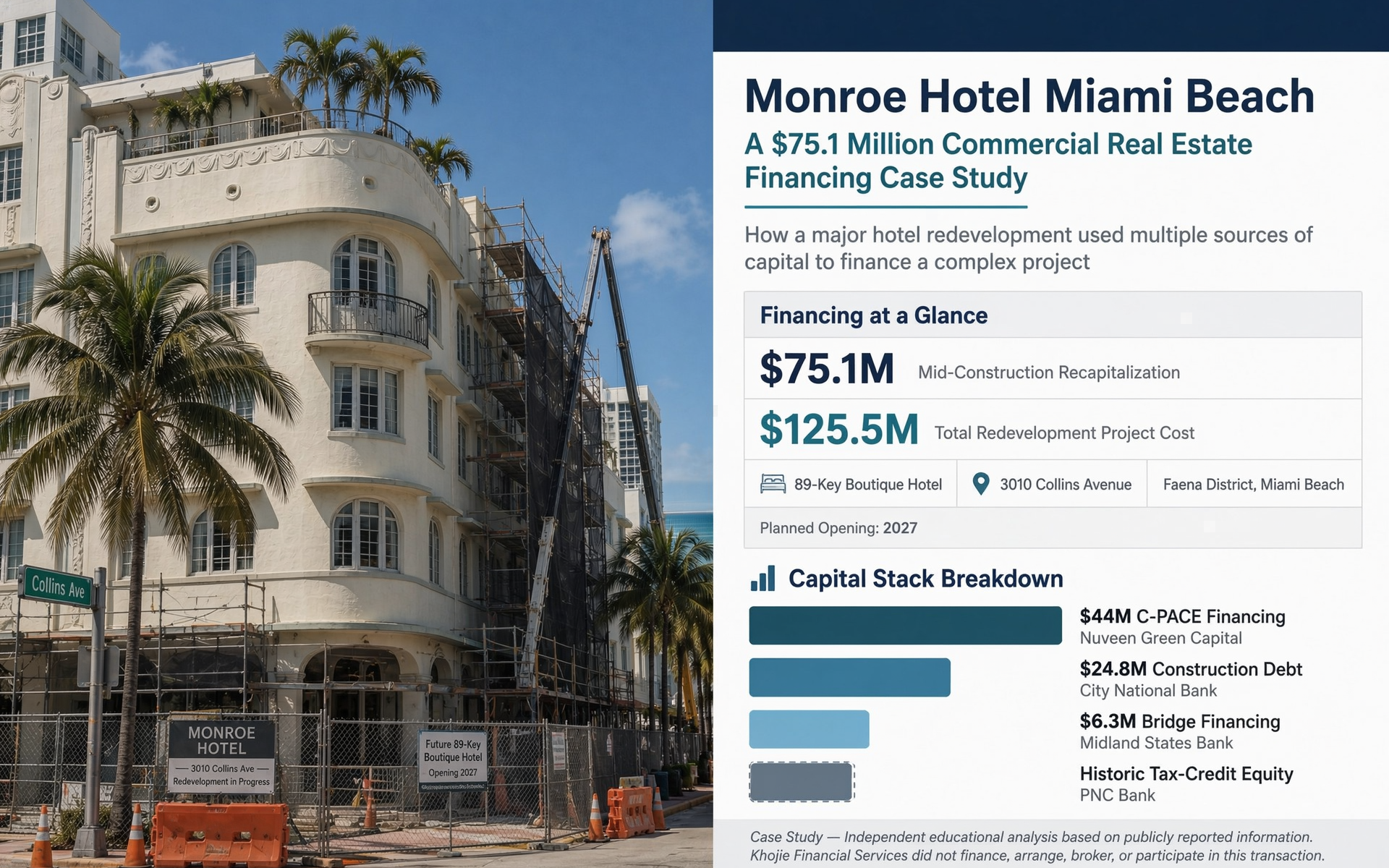
The Monroe Hotel, an 89-key boutique hotel being redeveloped at 3010 Collins Avenue in Miami Beach's Faena District, recently secured a reported $75.1 million mid-construction recapitalization as it moves toward a planned 2027 opening.
The financing is part of a much larger $125.5 million redevelopment project that will transform the historic property into a luxury boutique hotel featuring restaurants and bars, a rooftop venue, a spa and fitness center, a pool, private beach service and other amenities.
For business owners, real estate investors and entrepreneurs, the transaction provides a useful case study in an important financing principle: different parts of a project may be better suited to different sources of capital.
Important disclosure: Khojie Financial Services did not finance, arrange, broker or participate in the Monroe Hotel transaction discussed in this article. This is an independent case study based on publicly reported information and is intended for educational purposes.
According to Marcus & Millichap's announcement, IPA Capital Markets arranged the $75.1 million recapitalization for the property's ownership group.
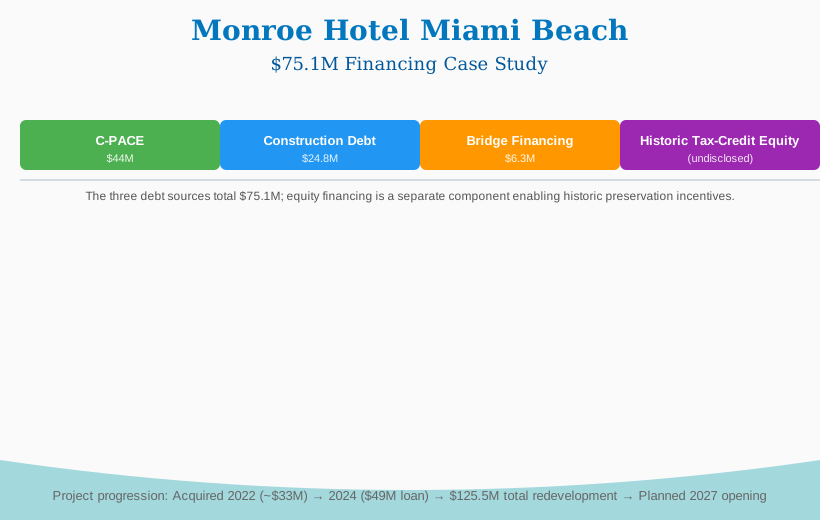
The reported capital stack included four sources:
- $44 million in C-PACE financing from Nuveen Green Capital
- $24.8 million in construction debt from City National Bank
- $6.3 million in bridge financing from Midland States Bank
- Historic tax-credit equity financing from PNC Bank
The transaction was structured as a mid-construction recapitalization, with two of the lending relationships representing new relationships for the property's sponsor.
The three specifically disclosed debt amounts total $75.1 million, while the announcement separately identifies historic tax-credit equity as another component of the four-source capital stack. The available announcement does not provide a separate dollar amount for the PNC historic tax-credit equity.
That distinction is important because a project's capital stack is not necessarily the same thing as a single loan.
Why Would a Project Need Multiple Sources of Financing?
At first glance, a $75.1 million financing package may look like a very large loan.
It is more useful to think of it as a collection of financing tools designed to address different parts of a project's capital requirements.
A construction loan, for example, may be designed to fund construction and redevelopment costs. A bridge facility can provide temporary capital while a project transitions between stages. C-PACE financing can address eligible energy-efficiency and resiliency improvements. Tax-credit equity can provide another source of project capital where a property qualifies for applicable historic preservation incentives.
Rather than forcing one financing product to accomplish everything, the project used a multisource capital structure.
That is one of the central lessons business owners can take from the Monroe case.
Financing should match the purpose
A business seeking financing should begin with a basic question:
What exactly is the capital going to accomplish?
Financing for equipment could involve an equipment leasing financing solution. Working capital needs may be addressed through a working capital loan or a business line of credit. Real estate acquisition, construction and renovation can have their own financing requirements—explore our business term loans for major investment or construction financing for development projects.
The Monroe transaction illustrates this principle on a much larger scale.
Case Study: Breaking Down the Monroe Capital Stack
1. Construction Debt: $24.8 Million
City National Bank provided $24.8 million in construction debt as part of the recapitalization.
Construction financing is generally designed around the costs and risks associated with developing or substantially improving a property.
Unlike a conventional business loan used for ordinary operating expenses, construction financing must account for factors such as project completion, construction costs, property value, timelines and the expected value of the completed asset.
For a hotel redevelopment, that can involve millions of dollars in renovation, construction, materials, labor, professional services and other project costs.
The key takeaway for smaller businesses is not that every company needs construction financing.
It is that the financing product should correspond to the underlying use of funds.
2. C-PACE Financing: $44 Million
One of the most notable components of the Monroe financing was the $44 million in Commercial Property Assessed Clean Energy, or C-PACE, financing provided by Nuveen Green Capital.
C-PACE is a specialized financing mechanism that can be used for qualifying improvements related to areas such as energy efficiency and resiliency.
For a Florida property, resiliency can be particularly relevant given the state's exposure to hurricanes and severe weather.
In the Monroe project, the C-PACE component demonstrates how a property owner can potentially incorporate a specialized financing source into a broader capital structure instead of relying exclusively on traditional construction debt.
This is an important distinction.
Alternative financing does not necessarily replace traditional financing. Sometimes it complements it.
3. Bridge Financing: $6.3 Million
The capital stack also included $6.3 million in bridge financing from Midland States Bank.
Bridge financing is generally designed to provide temporary capital while a borrower moves from one financing or project stage to another.
For businesses, bridge financing can sometimes be relevant when timing creates a temporary capital gap—for example, when an expected source of permanent financing has not yet closed or when an asset or transaction is moving through a transition period.
The Monroe transaction illustrates why timing can be just as important as the amount of financing.
A business may have sufficient assets or a viable project but still need the right type of capital at the right point in the project lifecycle.
4. Historic Tax-Credit Equity
The fourth identified source was historic tax-credit equity financing from PNC Bank.
This is particularly relevant because the Monroe is a historic property undergoing a major redevelopment.
The project therefore demonstrates another important financing concept: the characteristics of the underlying asset can influence the sources of capital available to the owner.
A historic property, for example, may have financing opportunities that would not apply to a conventional commercial property.
For business owners, the broader lesson is to understand the characteristics of the business or asset before deciding what financing to pursue.
From Acquisition to Redevelopment
The Monroe's financing story did not begin with the $75.1 million recapitalization.
According to the reporting surrounding the project, the property was acquired in 2022 for approximately $33 million. It subsequently progressed through additional financing as the redevelopment advanced, including a reported $49 million loan in 2024.
The current redevelopment has a total project cost of approximately $125.5 million.
This progression illustrates another important concept:
Financing needs can change as a business or project evolves.
A company may need one type of capital when it is starting out, another when it is expanding, and another when it acquires assets or undertakes a major capital project.
The same principle applies to commercial real estate.
The financing appropriate at acquisition may not be the financing appropriate during construction or redevelopment.
What Business Owners Can Learn From the Monroe Hotel Case
Although the Monroe Hotel is a large commercial real estate project and is far different from the financing needs of most small businesses, several principles are broadly applicable.
1. Start With the Use of Funds
Before looking for a loan, determine exactly what the money will accomplish.
Are you:
- Purchasing equipment?
- Expanding operations?
- Refinancing existing debt?
- Purchasing inventory?
- Funding working capital?
- Acquiring another business?
- Renovating commercial property?
- Financing a construction project?
The answer can influence which financing options make sense.
2. One Financing Product Does Not Always Fit Every Need
The Monroe transaction is a clear example of a project using multiple financing sources.
For smaller businesses, the same principle can apply in a different form.
A company might use a term loan for a major investment while maintaining a line of credit for working capital needs. Another business might combine its own capital with outside financing for an expansion through invoice factoring or revenue-based financing.
The appropriate structure depends on the business, its financial position, the purpose of the funds and the financing options available.
3. The Capital Stack Matters
The term capital stack is often associated with sophisticated commercial real estate transactions, but the underlying concept is straightforward.
It refers to the different sources of capital supporting a project or business.
Those sources can have different costs, repayment structures, risks and priorities.
Understanding the capital stack can help owners think beyond the simple question of:
"How much can I borrow?"
A better question may be:
"What combination of capital best supports the project while keeping the financing structure sustainable?"
4. Timing Can Be Just as Important as Amount
The Monroe financing occurred mid-construction, rather than simply at the beginning of the project.
That matters.
A business can have a strong opportunity but still experience a financing gap because capital is needed at a particular point in time.
Planning financing around the company's timeline can therefore be just as important as determining the desired loan amount.
What This Means for Small and Mid-Sized Businesses
Most small businesses will never need a $75.1 million recapitalization.
They don't need to.
The value of this case study is the financing strategy—not the size of the transaction.
Whether a company is seeking $50,000, $500,000 or several million dollars, the same fundamental questions are worth asking:
What will the financing accomplish?
How quickly is the capital needed?
What repayment structure makes sense for the business?
Does the business need one financing product or a combination of sources?
What does the company's financial profile support?
These questions can help business owners approach financing more strategically rather than simply searching for the largest available loan.
Financing Is About More Than the Loan Amount
The Monroe Hotel case demonstrates that sophisticated financing is often about structuring capital around a specific objective.
The project combined construction debt, C-PACE financing, bridge financing and historic tax-credit equity to support a major redevelopment.
That does not mean the same structure would be appropriate for another hotel, another real estate project or a small business.
It does demonstrate an important principle:
The right financing strategy starts with understanding the project.
For business owners, that means evaluating the purpose of the capital, the amount required, the timing, the company's financial position and the available financing options before deciding how to proceed.
At Khojie, we believe business financing should begin with understanding the business and its objectives—not simply matching a company with a loan amount.
If your business is exploring financing for expansion, working capital, equipment, acquisition or other business needs, learn more about the SBA loan and commercial financing options available through Khojie.
Ready to explore financing options for your business?
Take the funding quizSources and Disclosure
This case study is based primarily on publicly reported information concerning The Monroe Hotel's $75.1 million recapitalization, including the September 2026 announcement from Marcus & Millichap's IPA Capital Markets and reporting by Hoodline.
Khojie Financial Services is not affiliated with The Monroe Hotel transaction and did not arrange, provide or participate in the financing described above. This article is provided for educational and informational purposes only. Financing availability, terms and qualification requirements vary by lender, borrower and transaction.